Energy Solutions
300 Wh/kg goal
Reaching it with graphene nanotubes reinforced Si/C anodes
Why are electric vehicles not yet affordable to the masses?
Batteries! Today, electric vehicles (EVs) cost an average of 25% more than their petrol-powered equivalents because their battery packs are so expensive.
So, how can we overcome this?
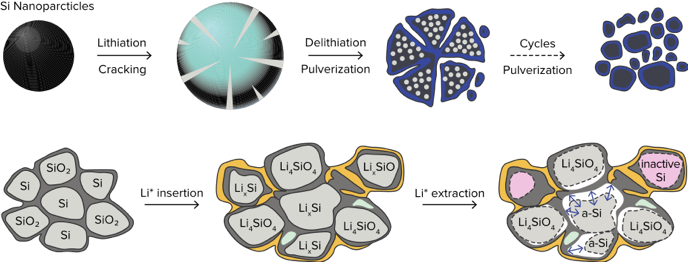
The main idea for improving the energy density of battery cells has been to use silicon in the anodes. However, this has a negative effect on the cycle life of the batteries.
PULVERISATION PROBLEM OF Si ANODES
What is the solution?
TUBALL E-nable Si/C anode, by solving its key problem – poor cycle life, due to swelling and cracking in the process of charge and discharge.
MEETING INDUSTRY STANDARDS WITH GRAPHENE NANOTUBES
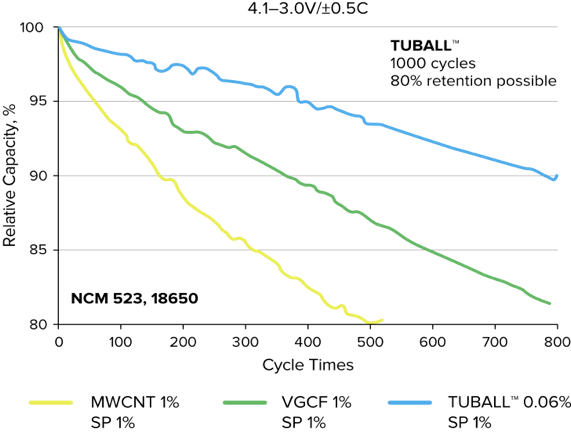
MAXIMISING ENERGY-DENSITY OF CATHODES
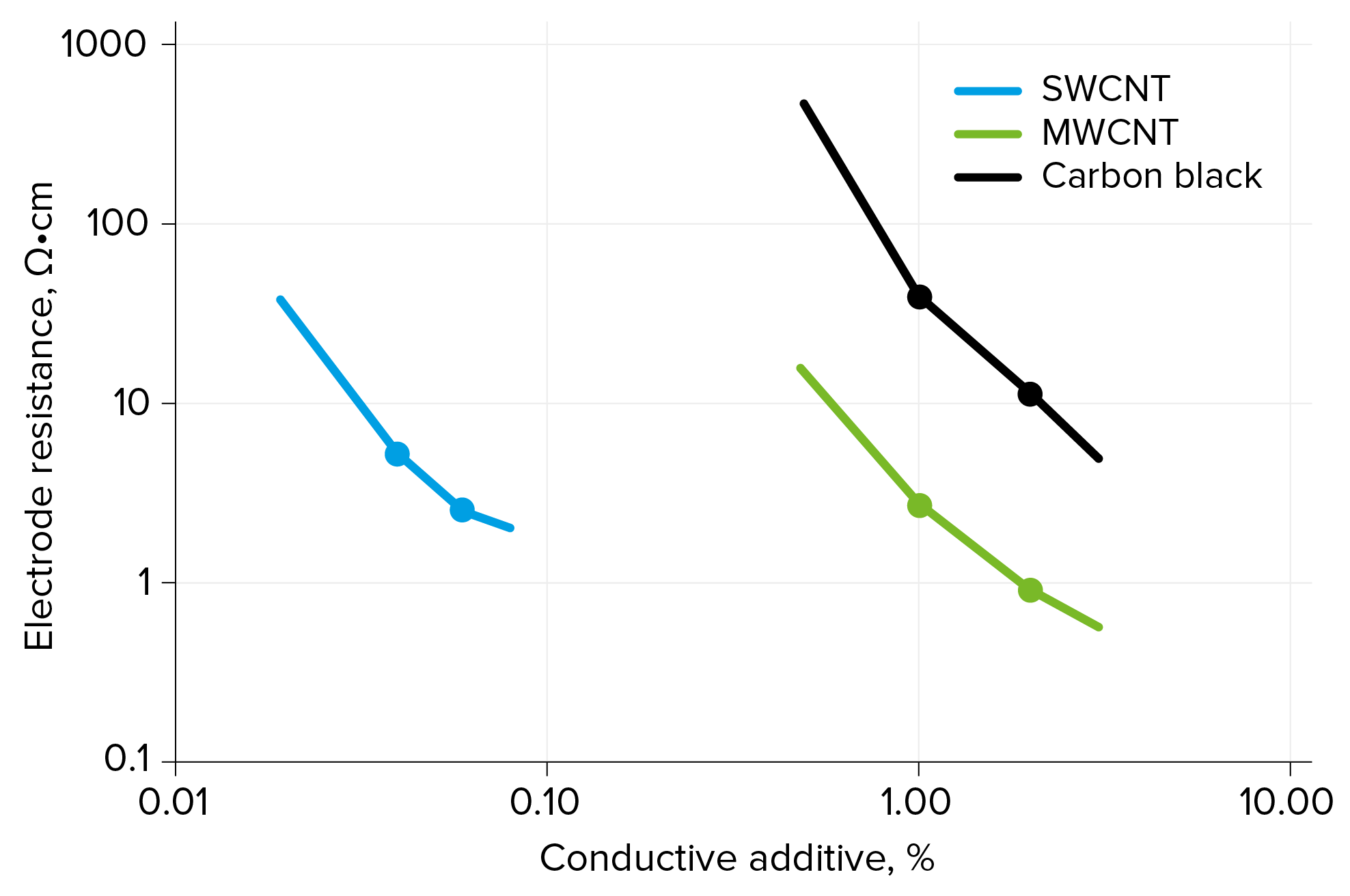
| 3-4 kg of conductive carbon black in EV can be replaced with 100 g of graphene nanotubes |
TUBALL nanotubes facilitate stable conductive network:
- Slower DCR growth
- Better cycle life
- Improved c-rate
Si/C ANODES | HIGH-PERFORMANCE CATHODES |
CYCLE LIFE. Increase cycle–life of high–energy Si/C anodes with only 0.05% of graphene nanotubes, allowing their adoption in LIB to reach 300 Wh/kg energy density | ENERGY DENSITY. Maximise energy with only 0.06%\u2028of graphene nanotubes: by using up to 99% of active material in modern high-energy NCM and other cathodes SAFETY AND STABLE PERFORMANCE. Slower DCR growth, improved cycle life and c-rate performance can be achieved with adding as low as 0.01% of graphene nanotubes on top of other conductive additives |
 Tuball BATT H2O Application: Energy Storage Materials: Graphite Anodes, Si Anodes Carrier Media: water, PVP, CMC, PAA, other Packaging: Bottle, Jerrycan Weight: 100 ml, 1 L, 5 L |  Tuball BATT NMP Application: Energy Storage Materials: Cathodes, LCO, LFP, NCM Carrier Media: NMP, PVDF Packaging: Bottle, Jerrycan Weight: 100 ml, 1 L, 5 L |
For more info contact energy@ocsial.com