Protective enclosures
Graphene nanotubes for composite protective enclosures: electrical safety and durability
Graphene nanotubes provide SMC composites with permanent anti-static performance, even under extreme temperature, humidity, and chemical exposure. Such materials are ideal for manufacturing protective enclosures, such as control panels and dashboards, transformer housings and junction boxes, control units and monitoring devices, for the electronics industry and other ATEX/IECEx zones, safeguarding equipment from becoming an ignition source in hazardous areas.
These anti-static sheet molding compounds enhanced with nanotubes maintain their original flame retardancy, mechanical strength, and design flexibility. Supplied in ready-to-use forms, nanotubes enable clean, dust-free processing compared to carbon black and are fully compatible with standard manufacturing equipment and technologies.

Contact us to discuss your project specifications or to request a TUBALL™ product sample
Main properties
Surface resistivity
10⁶–10⁹ Ω/sq
Mechanical
durability
Original flame retardancy


Graphene nanotubes for thermoset composites

Why choose SMC composite enclosures?
Protective enclosures are commonly made from carbon steel, stainless steel, aluminum, thermoplastics, and composite materials. Compared with conventionally used materials, which may have drawbacks such as limited corrosion resistance, lower mechanical robustness, restricted temperature resistance, or high cost, sheet molding composites stand out by providing overall high performance. They combine high mechanical strength with excellent corrosion resistance, offer flame-retardant properties and, when enhanced with graphene nanotubes, provide anti-static performance for use in hazardous environments. As a result, SMC enclosures represent a durable, low-maintenance solution for demanding industrial and outdoor applications.

Graphene nanotubes surpass other conductive agents
TUBALL™ graphene nanotubes provide permanent, humidity-independent anti-static performance at ultralow loadings, preserving mechanical strength and design flexibility. Unlike migratory additives, they do not leach out or depend on environmental conditions, making them suitable for long service life and ATEX/IECEx applications. Compared to carbon black and metal fillers, graphene nanotubes achieve conductivity without added weight, color limitations, corrosion risks, or reduced surface and insulation properties, delivering lightweight, durable, high-performance anti-static solutions.
- Diagram
- Table

- TUBALL™ graphene nanotubes
- Carbon black
- Liquid anti-static agents
* This diagram provides average trends compared with other additives, based on OCSiAl data. Product performance may vary depending on product type and formulation.

Conductivity with variety of colors
Preserving the color close to original color of the system is possible due to TUBALL™ graphene nanotubes’ ultralow working dosages, starting at just 0.01 wt.%, and minimal graying effect. Nanotubes create a 3D network within SMC composites, delivering homogeneous electrical resistivity without insulative spots.

Contattaci per discutere le specifiche del tuo progetto o per richiedere un campione di TUBALL™ MATRIX

Additional benefits
Clean production

Limited impact on viscosity and thixotropy


Ready-to-apply solutions
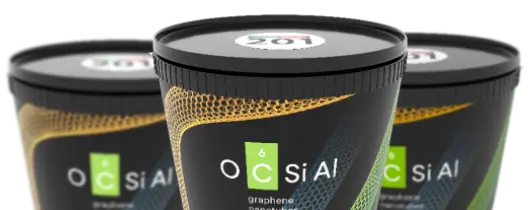
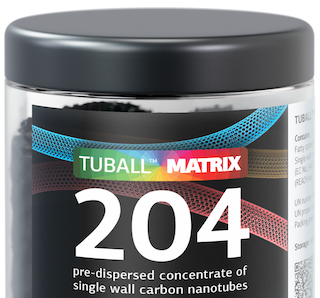
TUBALL™ MATRIX are concentrates based on polymer-carriers and pre-dispersed TUBALL™ graphene nanotubes. They are specifically designed for polyester and vinyl-ester composites and coatings. The concentrates can be added during the compounding stage, maintaining the ability to mold complex geometries, and they are fully compatible with standard SMC processing.
Contattaci per ricevere le linee guida sulla lavorazione dei prodotti e ulteriore documentazione tecnica

TUBALL™ MATRIX 204
Additivo conduttivo universale a base di plasticizzante con un agente stabilizzante per i rivestimenti in poliestere e in vinilestere, da utilizzare con melammina e con solventi acrilici. È anche consigliato per i compositi di poliestere e di vinilestere
Related video
TUBALL nanotubes for thermoset composites: conductivity and reinforcement
Scientific validation

Composites
Interlocking Matrix and Filler for Enhanced Individualization and Reinforcement in Polymer–Single-Walled Carbon Nanotube Composites
SWCNT-enhanced polymer, in which every monomer is decorated with a U-shaped fragment, exhibits significantly increased mechanical properties when compared to the matrix polymer.
Pubblicato:

Composites
Fabrication And Characterization Of SWCNT-Reinforced Polyester Nanocomposites Using Tensile Test And Nanoindentation Techniques
The results of mechanical tests exhibit improvements of Young’s modulus and hardness by 35% and 29%, respectively. In addition, the elastic modulus determined by the nanoindentation technique differs from the one obtained from tensile tests by 16%.
Pubblicato:
Composites
Polarization and relaxation mechanisms in glass fiber-reinforced LED-cured polyester composites incorporating graphene nanotubes
The electrical and dielectric features of the LED-cured polyester resin composite reinforced with graphene nanotubes were shown to have a good conductivity mechanism.
Pubblicato: