Graphene nanotubes conductive agent for lining coatings
TUBALL graphene nanotubes add electrical conductivity to lining coatings, while preserving mechanical properties and allowing light colors to facilitate visual inspections.
TUBALL graphene nanotubes are applied via easy-to-use TUBALL MATRIX, which is a line of additives based on polymer carriers and pre-dispersed TUBALL graphene nanotubes.
Please, choose TUBALL MATRIX based on carrier medium, which suites your formulation:
Target system
Solvent-free epoxy
Solvent-based epoxy
Additive carrier
Plasticizer
Surfactant
Plasticizer & stabilizing agent
Fatty acid glycidyl ester
Alkyl glycidyl ether
Ethoxylated alcohol
Fatty acid glycidyl ester, ammonium salt of polyolefins-based derivative
Alkyl glycidyl ether, ammonium salt of polyolefins based derivative
Product
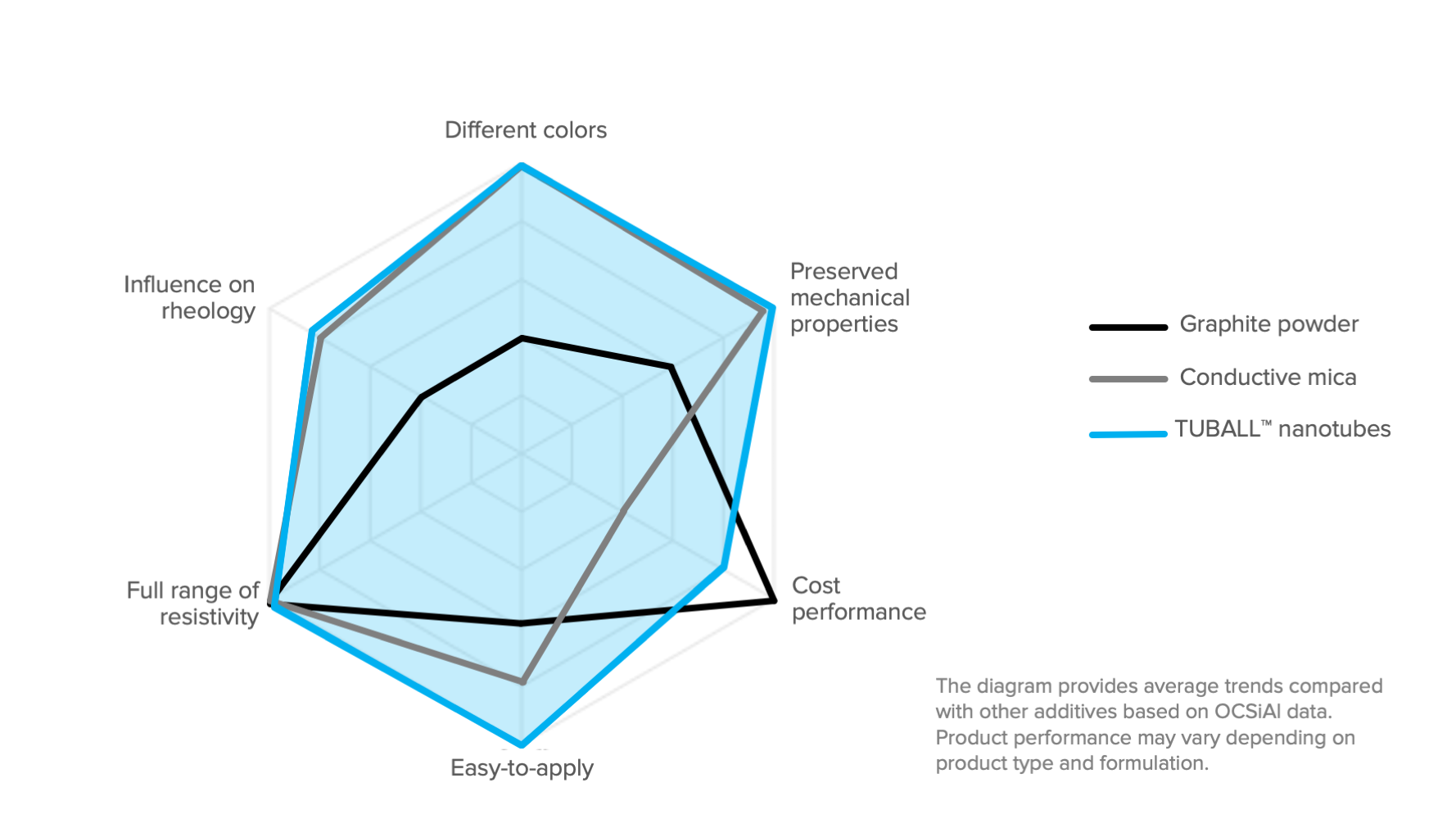
TUBALL GRAPHENE NANOTUBES ARE A VERSATILE CONDUCTIVE AGENT OFFERING STRONG PERFORMANCE IN ALL KEY PARAMETERS
Preserved light colors
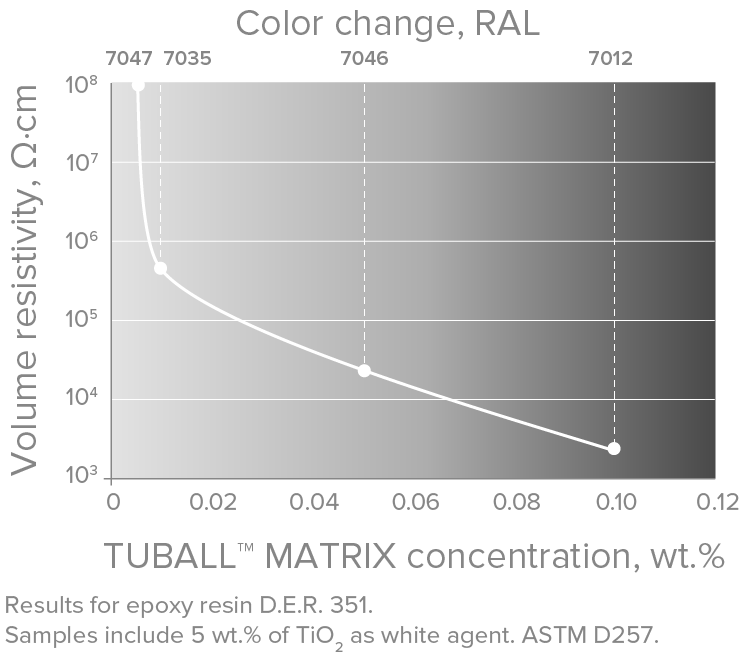
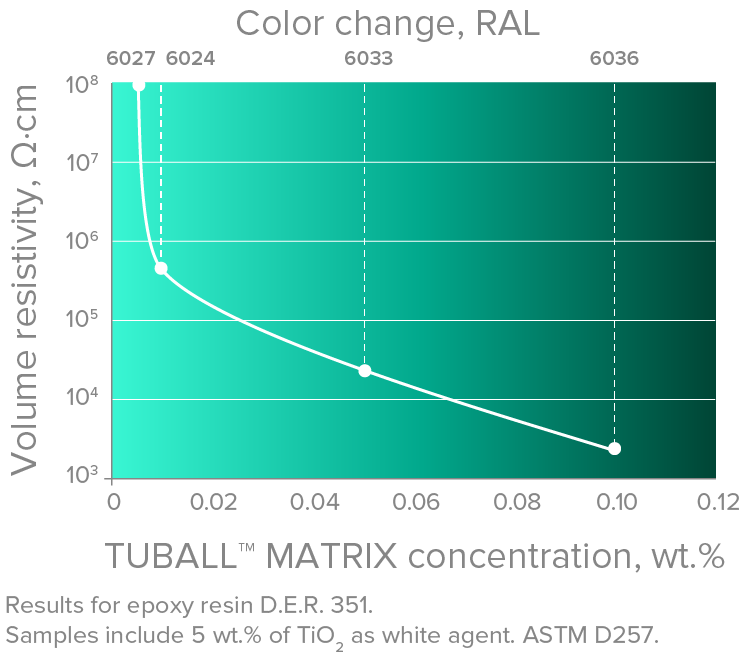
The use of TUBALL graphene nanotubes via TUBALL MATRIX additive provides a full range of electrical resistivity of 108–104 Ω·cm, while allowing for a wide range of light colors to meet customer requirements, including facilitating visual inspections and more efficient servicing.
Maintained mechanical properties
TUBALL nanotubes, in contrast to traditional conductive agents, maintain the mechanical properties of the original non-conductive epoxy coating, resulting in a high level of durability and a prolonged service life.
Preserved adhesion
Maintained impact resistance
Maintained resistance to cracking
ISO 2409. No detachment of coating from substrate after cross-cut adhesion test
ISO 6272. Full resistance to falling 1 kg weight indenter impact from 50 cm height directly to the coating and from the opposite side
ISO 1520. Full resistance of coating to cracking and detachment from a substrate by indentation to 7 mm depth
Easy-to-apply
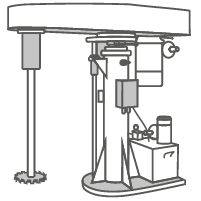
TUBALL MATRIX can be processed with standard equipment widely used in the coating industry:
Standard single shaft high speed mixer
25 min total dilution time
Instant quality control with a grindometer to reach particle size ≤ 15 µm
Other benefits provided by TUBALL nanotubes for lining coatings:
• Less influence on rheology compared to other conductive additives
• Low dosage gives greater flexibility in the final formulation and means less need for solvent usage
• Electrical resistivity stable over time and independent of humidity without “hot spots”
• Consistent quality for large industrial batches
• Ease of application and low dosage makes logistics less complex and more efficient
TUBALL graphene nanotubes are applied via easy-to-use TUBALL MATRIX, which is a line of additives based on polymer carriers and pre-dispersed TUBALL graphene nanotubes.
Conductive lining coatings applied in tanks for storage and transportation of flammable chemical products have technical requirements for both producers of lining coatings as well as for service companies. The choice of a conductive agent becomes critically important in order to provide the required electrical conductivity while maintaining the properties of the initial coating. TUBALL graphene nanotubes are an effective alternative to carbon black and conductive mica.
Conductive lining coatings enhanced with TUBALL nanotubes are widely applied in:
• Containers for flammable substances including alcohols
TUBALL graphene nanotubes, also known as single wall carbon nanotubes, can be used in the production of lining coatings in compliance with the following standards and recommendations: EN 14015, TRbF 401, GOST (ГОСТ 1510-84), NFPA 77, etc.
Contact us to discuss your project specifications or to request a TUBALL MATRIX sample.