Single Wall Carbon Nanotubes for Thick Electrodes
Single wall carbon nanotubes, also known as graphene nanotubes, each approximately 1.6 nanometers in diameter and 5 microns in length, exhibit a distinctive aspect ratio surpassing 3,000. This unique length allows nanotubes to form robust networks, connecting particles of active battery material and enhancing the overall conductivity and strength of electrodes.
| A thick electrode design has the potential to significantly enhance the loading of electrode active material by minimizing the use of non-active materials in batteries. This improvement aims to enhance the energy density of the batteries and reduce overall costs. However, thick electrodes face limitations due to their weak mechanical stability and poor electrochemical performance. |
The thicker the electrode, the more crucial the need for uniform conductivity throughout its volume. The drawback of using carbon black or multi-wall carbon nanotubes lies in nonuniform conductivity throughout the thickness of the electrode, as these materials tend to migrate towards the electrode surface during the drying process. Single wall carbon nanotubes address both issues by ensuring uniform conductivity and enhancing the mechanical characteristics of the electrode, eliminating the risk of cracks. The mechanical strength and flexibility of the electrode are achieved through the nanotubes' ability to improve cohesion between particles of the electrode.
Graphite anode example
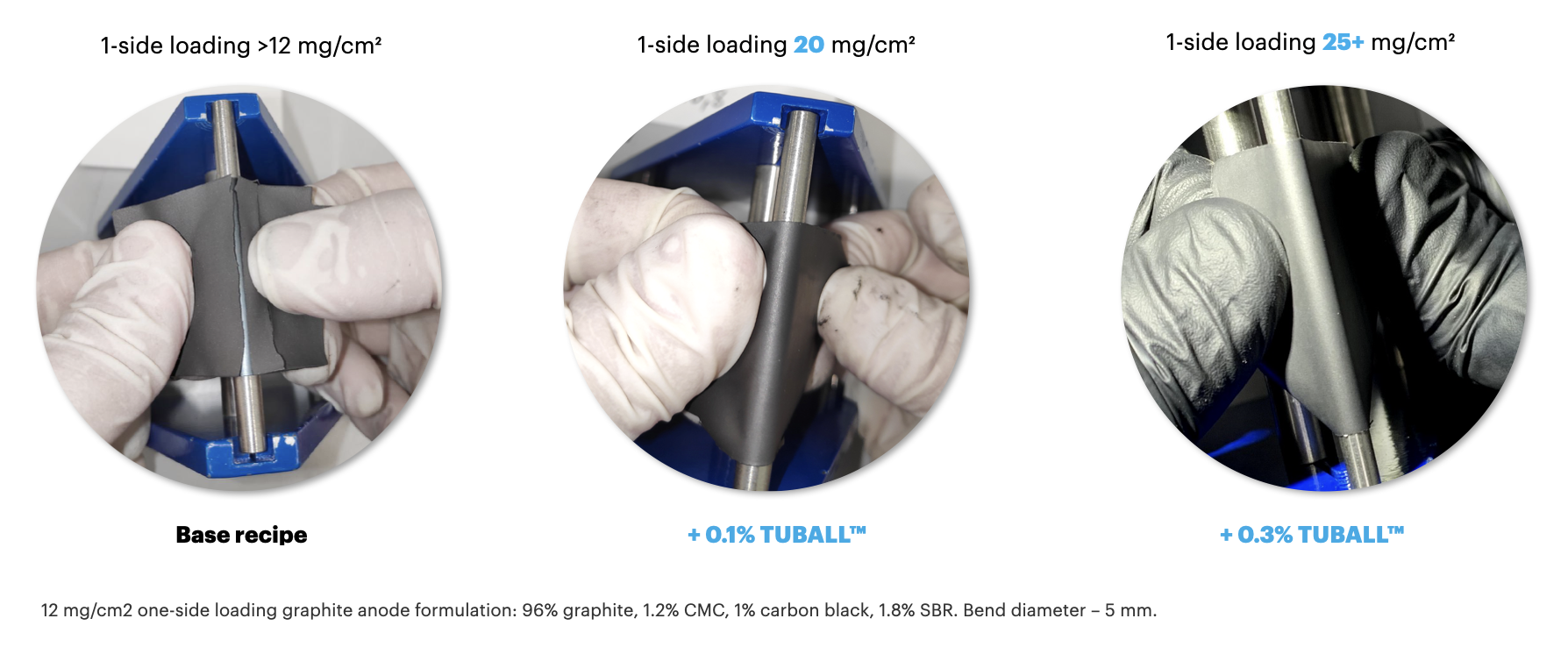
Tests reveal that the original anode without nanotubes is prone to cracking (as seen in the left image). However, samples with TUBALL™ nanotubes added to the original formulation exhibited no cracks, even with one-side loading of up to 25 mg/cm².
LFP cathode example
No cracks in the electrode with TUBALL™ even at very high electrode loadings.
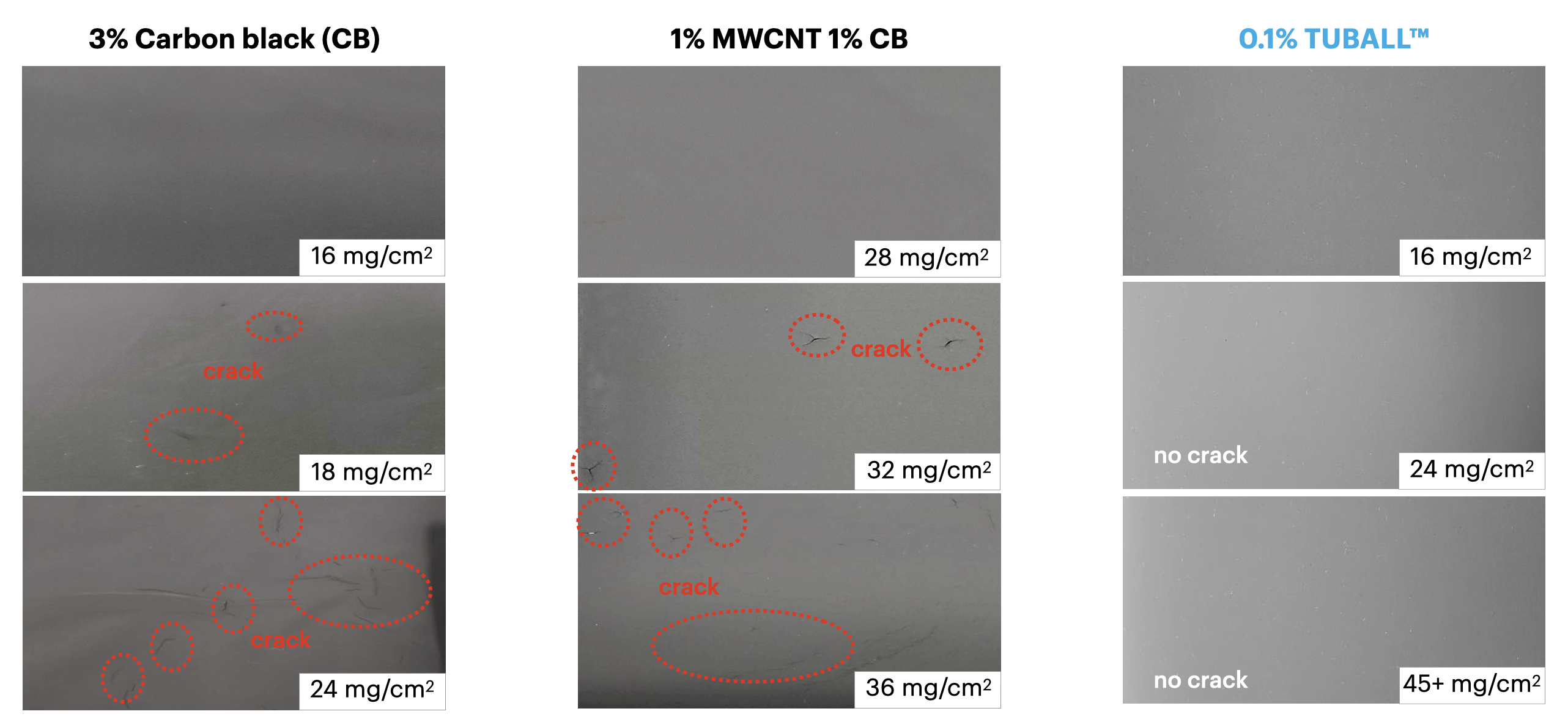
The performed test focused on maximizing one-side loading of the LFP cathode until cracks started to appear on the surface of the electrode. The formulation with carbon black (left image) exhibited cracks at a loading of 18 mg/cm². The multi wall carbon nanotube formulation (middle image) indicated cracks at 32 mg/cm² per one-side loading. In contrast, the TUBALL™ single wall carbon nanotube formulation (right image) did not show cracks even at a loading above 45 mg/cm². Maximizing one-side loading is highly demanded in ESS applications today, where energy density and economy are the primary focus.
Robust TUBALL™ networks make it possible to create electrodes with record-high electrode thickness by strengthening the bonds between active material particles.


Related videos:
How do nanotubes work inside an electrode?
Contact us to discuss your project specifications or to request a sample