Single Wall Carbon Nanotubes for Anodes
Single wall carbon nanotubes, also known as graphene nanotubes, with their unique intrinsic properties and an extraordinary aspect ratio of over 3,000, can form robust, long-distance electrical networks. Nature's longest and most flexible material for conductivity and reinforcement of electrode, they connect electrode particles, surpassing the performance of other carbon-based materials for batteries.
| The lithium–silicon battery is a subclass of lithium-ion battery technology that utilizes a silicon-based anode and lithium ions as the charge carriers. Silicon-based materials typically exhibit a much larger capacity compared to graphite. However, a significant challenge to their industrial adoption is the high volume expansion and contraction of silicon particles during each charge/discharge cycle, which ultimately results in premature degradation of the cell. |
TUBALL™ unlocks mass production of EV batteries with silicon anodes
TUBALL™ single wall carbon nanotubes cover the surface of the silicon particles and create highly conductive, durable connections between them. These connections are so dense, long, conductive, and strong that even when the silicon particles in the anode expand and the material starts to crack, the particles stay well connected to each other through the TUBALL™ graphene nanotubes. This prevents the anode from going out of service—the hugely improved cycle life is enough to meet even the strictest EV manufacturer requirements.
TUBALL™ solves the silicon anode problem, preventing its degradation.

Silicon-based anodes: 10% SiOx/SiC
Drastically improved cycle life with small addition of TUBALL™.
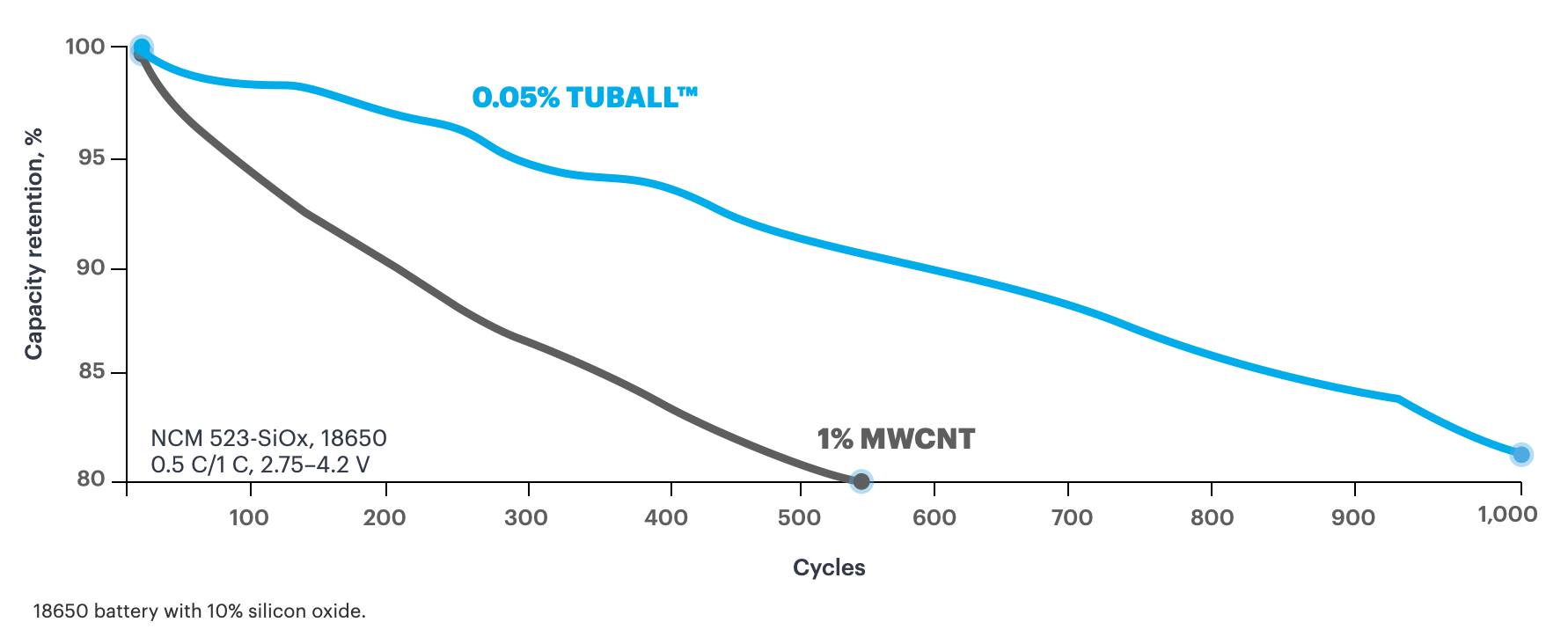
The addition of 0.05% TUBALL™ single wall carbon nanotubes results in an almost doubled cycle life compared to multi-wall carbon nanotubes with a dosage 20 times higher. Graphene nanotubes can establish reliable connections between silicon anode particles in various types of silicon, including silicon oxide, silicon carbon, and metallurgical-grade silicon.
Silicon-based anodes: 90% SiOx/SiC
The more silicon in the anode, the more essential the use of graphene nanotubes in the design becomes.
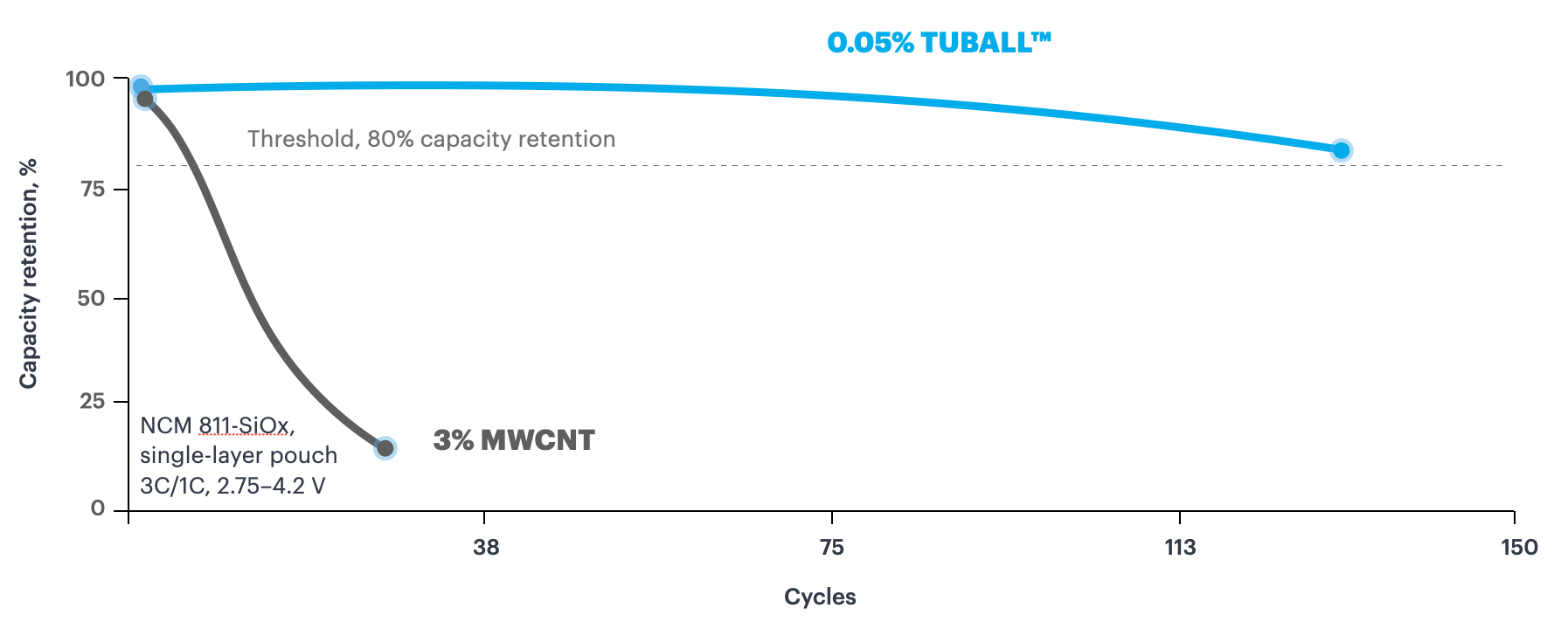
In high silicon-containing systems, short rigid carbon nanostructures, such as multi-wall or few-wall carbon nanotubes, cannot demonstrate good cycling performance. Conversely, TUBALL™ nanotubes exhibit unparalleled results that cannot be achieved with any other conductive additive.

Related videos:
How do nanotubes work inside an electrode?
Contact us to discuss your project specifications or to request a sample