Anti-static industrial flooring
Graphene nanotubes for ESD floors: standards compliance & flexibility in color and thickness
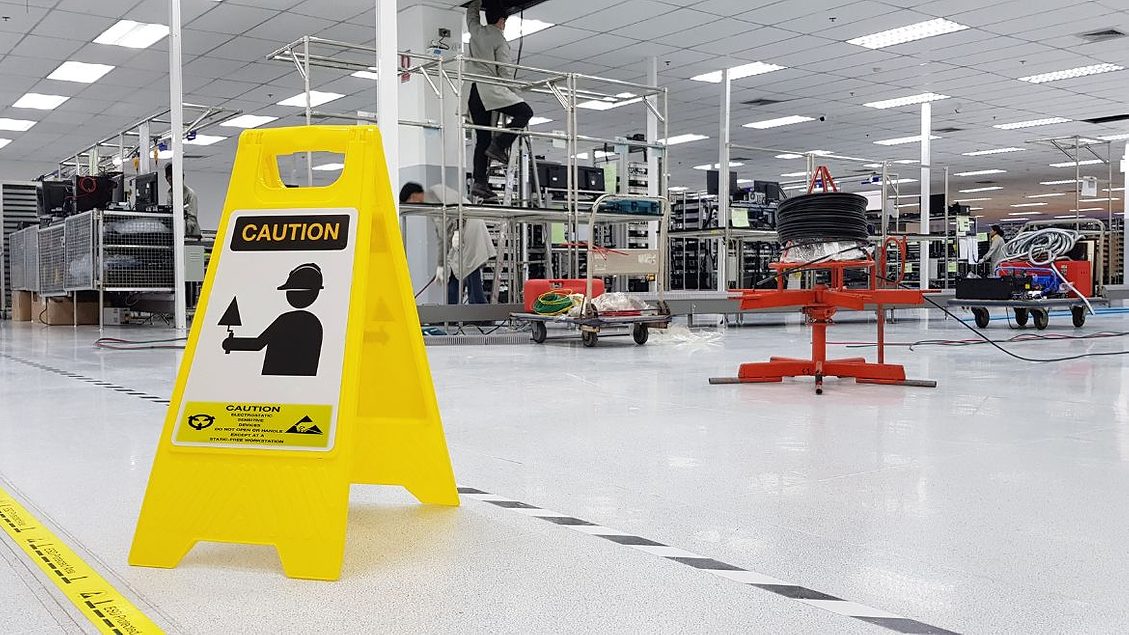
Industrial floors in high technology sectors, the pharmaceutical and automotive industries, and cleanrooms require anti-static characteristics. Graphene nanotubes provide flooring unmatched performance by granting permanent, homogenous electrical conductivity without hot insulative spots and visual black dots, remaining stable regardless of humidity and allowing the flooring to pass the walking body voltage test. The extremely low dosage of easy-to-use graphene nanotube concentrates makes it possible to maintain the original mechanical abrasion resistance, impact resistance, and chemical resistance of the resin.

Contact us to discuss your project specifications or to request a TUBALL™ product sample
Main properties
Stable resistance
without "hot insulative
spots" 10⁴–10⁹ Ω
Clear, colorful surface
without black dots
Flexibility in floor
thickness
Standard processing
and equipment

ESD flooring with graphene nanotubes for enhanced safety

How does anti-static flooring work?
An ESD conductive flooring system can be comprised of layers such as copper tape, conductive primer, a base coat, and a thin topcoat. To conduct electrical charge from the surface to the ground, the originally insulative base coat should be made conductive. Self-leveling ESD floors must meet surface-to-surface or surface-to-ground resistance requirements, complying with IEC 61340-4-1, ASTM F150-06, and ANSI / ESD S20.20 standards.


Nanotubes outperform standard additives for electrostatic discharge floors
Ultra-strong, ultra-long, electrically conductive and flexible, graphene nanotubes create a 3D conductive network inside the material at extremely low working dosages. This allows them to be a versatile conductive agent offering strong performance on all key parameters.
- Diagram
- Table

- TUBALL™
- Conductive pigments
- Chopped carbon fibers

Permanent and stable resistivity over time
Added to resin, graphene nanotubes create a stable, permanent electrical pathway from the walking surface to the ground and dissipate electrostatic charge over time regardless of humidity.


Full range of electrical resistivity while preserving color
Ultralow working dosages of graphene nanotubes allow for wide color flexibility while ensuring a wide range of stable electrical resistivity.


Low working dosages and flexibility in basecoat thickness
Compared with chopped carbon fiber and conductive mica, the required dosage of which is 5–20 wt.% leading to a higher price, graphene nanotubes make it possible to obtain the required conductivity at much lower working dosages starting from 0.01 wt.%, improving cost efficiency.

Surface-to-ground resistance at different base coat thicknesses
Due to the length of chopped carbon fiber (2 mm or longer), the base layer thickness must be at least ~2 mm, which complicates installation and raises costs. Additionally, the fiber’s morphology can potentially create insulating “hot spots.” In contrast, graphene nanotubes can be used with various anti-static flooring systems and thicknesses, ensuring stable, permanent surface-to-ground resistance, ultimately reducing ESD flooring costs.

Kontaktieren Sie uns, um Ihre Projektspezifikationen zu besprechen oder ein TUBALL™ MATRIX-Muster anzufordern

Additional benefits
Make it possible to pass the walking body voltage test

Can be used without conductive primer

Flexibility in final formulation

Limited influence on viscosity and thixotropy

Ensures ESD floor walking test compliance


Industry-friendly forms of nanotubes allow standard processing
TUBALL™ MATRIX 200-x and 300-x series is a line of additives based on polymer-carriers and pre-dispersed TUBALL™ graphene nanotubes. They are designed to provide compatibility with standard processes and equipment. The concentrates can be added during the latex or polyurethane compounding stage and don’t affect the manufacturing process.
Kontaktieren Sie uns, um Verarbeitungshinweise für unsere Produkte und weitere technische Unterlagen zu erhalten

TUBALL™ MATRIX for solvent-free epoxy
TUBALL™ MATRIX 201
Leitfähiges Additiv auf Basis eines Weichmachers für lösungsmittelbasierte Epoxidbeschichtungen ohne Nachteile auf die Farbe und den mechanischen Eigenschaften

TUBALL™ MATRIX 207
Leitfähiges Additiv auf Basis eines Weichmachers für lösungsmittelbasierte Epoxidbeschichtungen ohne Nachteile auf die Farbe und den mechanischen Eigenschaften

TUBALL™ MATRIX for solvent-free epoxy and polyurethane
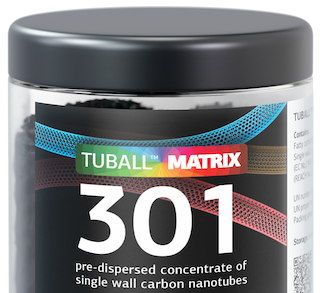
TUBALL™ MATRIX 301
Leitfähiges Additiv auf Basis eines Tensids für lösungsmittelfreie Epoxid- und Polyurethan-Beschichtungen ohne Nachteile auf die Farbe und den mechanischen Eigenschaften. Es wird auch für Epoxid-verbundstoffeempfohlen.
TUBALL™ MATRIX for solvent-free polyurethane
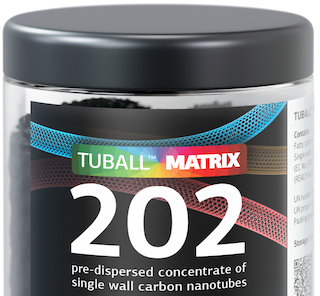
TUBALL™ MATRIX 202
Leitfähiges Additiv für aromatische und aliphatische lösungsmittelfreie PUs (Polyester, Polyether, TDI/MDI usw.) und Phenol-Systeme. Vielseitig anwendbar für PU-Beschichtungen und Gießelastomere. Minimale Einwirkung auf das Basis-Harz dank einer geringeren Arbeitsdosierung im Vergleich zu TUBALL™ MATRIX 209
TUBALL™ MATRIX for solvent-based epoxy and polyurethane
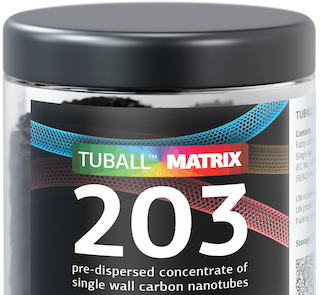
TUBALL™ MATRIX 203
Leitfähiges Additiv auf Basis eines Weichmachers mit einem Stabilisierungsmittel für lösungsmittelbasierte Epoxid- und PU-Beschichtungen ohne Nachteile auf die Farbe und den mechanischen Eigenschaften
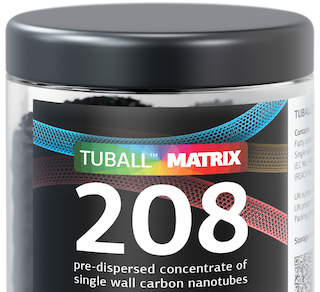
TUBALL™ MATRIX 208
Leitfähiges Additiv auf Basis eines Weichmachers mit einem Stabilisierungsmittel für lösungsmittelbasierte Epoxid- und PU-Beschichtungen ohne Nachteile auf die Farbe und den mechanischen Eigenschaften
Related video
Media on graphene nanotubes in floors
 Veröffentlicht:
Overcoming ESD-Control Flooring Challenges: A Comprehensive Guide to ANSI/ESD S20.20-2021
https://www.floortrendsmag.com/articles/110984-overcoming-esd-control-flooring-challenges-a-comprehensive-guide-to-ansi-esd-s2020-2021
Exploring the Ability of Graphene Nanotubes to Enhance Coating Safety, Durability, and Performance
https://digitaledition.pcimag.com/september-2022/feature-ocsial/ Veröffentlicht:
Single Wall Carbon Nanotubes. Fundamental Improvement in ESD Flooring with 0.01% Additive.
https://www.coatingsworld.com/issues/2017-03-01/view_features/single-wall-carbon-nanotubes/
Scientific validation
Floor coating
Raman Spectroscopy Unfolds the Fate and Transformation of SWCNTs after Abrasive Wear of Epoxy Floor Coatings
As a part of Diagonal EU project, FORTH, OCSiAl, STAT PEEL and other members examined TUBALL™ release from epoxy composites during abrasion tests. The level of nanotubes detected were below the LoQ.
Veröffentlicht: